
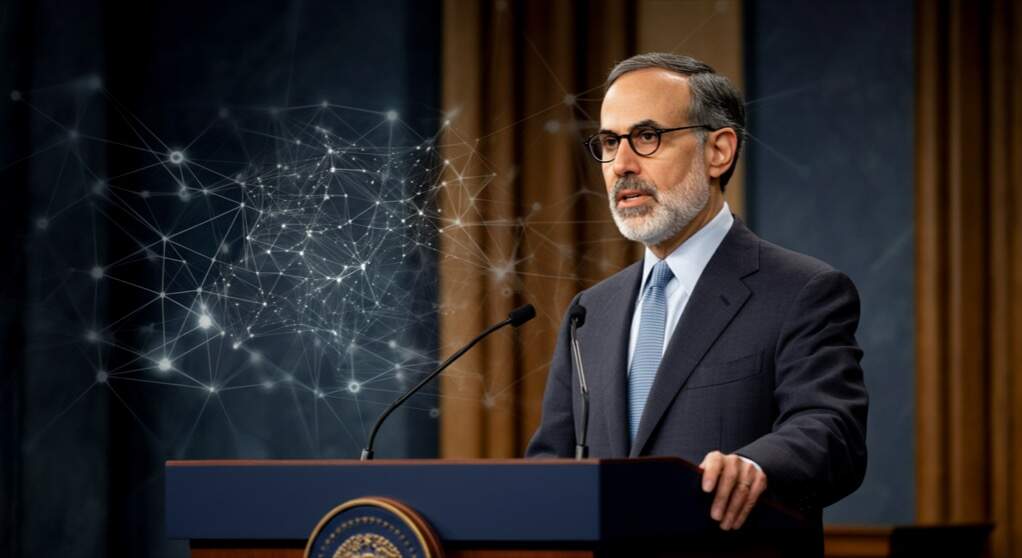
When a former Federal Reserve chair who managed trillions of dollars through the 2008 financial crisis agrees to sit on an AI company's governance board, the subtext is hard to miss: frontier AI is no longer being treated as a technology story. It is being treated as a systemic infrastructure story. Ben Bernanke, the Nobel Prize-winning economist who chaired the Fed from 2006 to 2014, has been appointed to Anthropic's Long-Term Benefit Trust, an independent body that holds the company accountable to its mission of responsible AI development. For founders building at the frontier, this appointment is worth more attention than any new model benchmark.
Who Bernanke Is and Why Anthropic Wanted Him
Bernanke's career spans three distinct phases that map directly onto Anthropic's governance needs. First, he spent more than two decades as an academic economist at Princeton, where he chaired the economics department and built a body of research on the role banks play in financial crises and the economic mechanisms of the Great Depression. That work earned him the Nobel Prize in Economic Sciences in 2022. Second, as Chair of the Federal Reserve from 2006 to 2014, he steered the U.S. economy through the worst financial crisis since the 1930s, making decisions that involved trillions of dollars in emergency lending and fundamentally reshaping how the central bank approaches systemic risk. Third, since leaving government, he has served as a Distinguished Fellow at the Brookings Institution, continuing to study how large-scale economic disruptions unfold.
Anthropic Co-Founder and President Daniela Amodei put it directly in the announcement: AI may have the most significant economic effects of any technology in modern history, and Anthropic has a dual responsibility to understand those effects and act on them. Bernanke's specific expertise in how economies react to disruptive moments makes him a natural fit for a company that is trying to anticipate how advanced AI will reshape workforces, industries, and entire economies. This is not a celebrity board appointment. It is a targeted hire of a specific skill set that Anthropic's governance structure was designed to need.
How the Long-Term Benefit Trust Actually Works
Anthropic is structured as a Public Benefit Corporation, which means the company is legally required to balance commercial success with generating social and public good. The Long-Term Benefit Trust is the mechanism that enforces that balance. The Trustees are independent of Anthropic's management and investors. They hold no equity in the company, do not share in its profits, and are compensated only for their time and service. New Trustees are selected by the existing Trustees in consultation with the company, creating a self-perpetuating governance layer that commercial pressure alone cannot dissolve.
The LTBT has the authority to appoint members to Anthropic's board of directors. Beyond that, the Trustees advise the board and leadership on critical decisions, particularly those involving potential risks and societal impacts of AI. Bernanke joins Chair Neil Buddy Shah, whose background is in global health and development; Richard Fontaine, who brings national security expertise; and Mariano-Florentino Cuellar, a former California Supreme Court justice with deep experience in law and policy. Their collective expertise spans global health, national security, law, policy, and now economics with Bernanke's addition.
This structure matters because it creates a firewall between commercial incentives and governance decisions. Anthropic's investors want returns. Its employees want stock appreciation. But the LTBT can make decisions that constrain both, and it has the independence to do so. For a company that has raised billions of dollars at valuations exceeding $60 billion, that independence is not a formality. It is a structural commitment that limits what the company can be forced to do even under intense financial pressure.
What This Means for AI Founders
Three implications stand out for founders. First, governance expectations for frontier AI companies are rising fast. When a former Fed chair sits on a governance board for an AI company, it sets a precedent that similar companies will be measured against. The bar for responsible AI governance is no longer a published safety policy. It is independent oversight with real authority. Founders raising large rounds or operating at the frontier should expect investors and partners to ask about governance structures in the same way they ask about unit economics.
Second, economic impact analysis is becoming a governance requirement, not a nice-to-have. Bernanke's specific mandate includes contributing to Anthropic's economic research. That signals that understanding how AI affects labor markets, productivity, and economic inequality is now part of what responsible AI development looks like. Founders who cannot articulate the economic implications of their technology will find themselves at a credibility disadvantage, particularly when engaging with policymakers or institutional investors.
Third, the LTBT model may become a template. Anthropic's governance structure is unusual today. But if frontier AI companies continue to grow in economic importance, the pressure to adopt similar independent oversight mechanisms will increase. The financial services industry went through this transformation after the 2008 crisis, with independent risk committees and board-level oversight becoming standard. AI governance may follow a similar arc, and the companies that adopt strong governance structures early will have a competitive advantage when regulation formalizes.
What Comes Next
Bernanke himself addressed the stakes in his statement: the potential of AI is enormous, and so is the range of outcomes. How that potential plays out will depend in part on the institutions we build around it. That is the core insight that founders should internalize. The technology itself is moving fast, but the institutions being built around it are what will determine whether the outcomes are broadly beneficial or narrowly captured.
The appointment also signals something about Anthropic's own trajectory. Adding a trustee with Bernanke's stature and specific policy expertise suggests the company is preparing for a world where AI governance becomes a formal regulatory domain. It is building the institutional infrastructure now, before regulators demand it. For founders, that is the playbook: build the governance structures that demonstrate responsibility before external pressure forces them on you. The Bernanke appointment is expensive talent on a trust that holds no equity. That is the price of credibility at the frontier.